Agentic Commerce
December 2, 2025
What is Agentic Commerce?
Agentic commerce describes a shift from user-initiated digital shopping to AI-initiated shopping, where software agents perform tasks on behalf of customers and merchants. Instead of a person manually searching, comparing, selecting products, and checking out, an agent handles these steps autonomously based on preferences, context, and structured data.
Agentic commerce does not replace ecommerce. It changes who performs the work or "toil". The interface moves from screens and clicks to intent and delegation.
1. The Core Idea: Delegated Digital Work
In traditional ecommerce the user carries out every step. In agentic commerce:
A customer agent evaluates options, interprets preferences, checks inventory, and selects products.
A merchant agent provides structured data, prices, availability, shipping options, and payment capabilities.
Payment and identity flows are handled through a standardised commerce protocol that agents can interpret.
The user reviews or approves the outcome, or receives the result with minimal interaction.
This shifts the transaction from a manual sequence to a machine-to-machine workflow.
2. The Protocols That Enable Agentic Commerce
Agentic commerce relies on interoperable standards that allow agents to discover products, initiate payments, and interact with merchant systems. Five protocols matter most.
AP2: Discovery and Ranking
AP2 defines how merchants supply structured product information that agents can read and compare. It establishes a common language for:
Product attributes
Price and availability
Variants
Delivery options
Metadata alignment across merchants
AP2 effectively becomes a new ranking system similar to SEO, where data quality determines visibility within agent results.
ACP: Checkout and Payments
ACP standardises how agents create carts, select SKUs, perform identity checks, and submit payments. It covers:
Item selection
Order construction
Payment initiation
Authentication
Confirmation
Instead of bespoke integrations, merchants expose a consistent agent-friendly checkout surface.
Network Protocols: Approvals, Trust, Routing, and Identity
Card networks and domestic payment networks are modernising the underlying messaging standards that support agent-led transactions. This includes:
Richer transaction metadata
Stable identity tokens
Continuous messaging rather than simple request-response patterns
Multi-rail orchestration across cards, wallets, and account-to-account flows
New authentication pathways that do not rely on device signals
Network upgrades enable secure approval decisions in an environment where agents, not human users, initiate transactions.
MCP: Tool Use and Enterprise Integration
The Model Context Protocol (MCP) allows agents to interact with business systems safely. It defines how models call tools, databases, and APIs through a secure and auditable layer. MCP is already being adopted as a standard for enabling:
Inventory lookups
Pricing checks
Account actions
Workflow automation
MCP is particularly important on the merchant side, where agents need controlled access to operational data.
A2A: Direct Bank-to-Bank Rails
Account-to-account payment systems provide an alternative to card rails for agent-initiated payments. They offer:
Lower costs
Near-instant settlement
Strong identity frameworks
Clear user consent flows
A2A will sit alongside card networks as a core option, and agents will choose between them based on cost, speed, approval likelihood, and incentives.
3. Customer Agents and Merchant Agents
Agentic commerce involves two interacting systems.
Customer Agents
Customer agents identify what the user wants and evaluate options based on:
Price
Preferences
Delivery speed
Availability
Merchant reputation
Historical behaviour
They produce a ranked set of outcomes and may act directly depending on the user’s level of delegation.
Merchant Agents
Merchant agents respond with:
Structured product data
Accurate pricing
Real-time stock information
Fulfilment options
Payment methods and routing preferences
Identity and token capabilities
Their role is to ensure the customer agent receives predictable, high-quality information that supports the best outcome.
4. Why Agentic Commerce Matters for Merchants
a. Higher Approval Rates
Agents send cleaner, more predictable data, and network protocols provide more stable identity signals. This can improve:
Authorisation rates
Fraud detection
Challenge rates
End-to-end conversion
b. Smarter Payment Routing
Agents allow dynamic selection of the optimal payment method based on:
Likelihood of approval
Cost to serve
Network incentives
Customer preferences
This creates a natural alignment between approvals and cost optimisation.
c. Better Cost Efficiency
Standardised protocols let merchants influence how payments are made. For example:
Steering to cheaper payment methods
Adjusting incentives in real time
Choosing the lowest-cost capable rail
d. Migration From Device-Based Signals to Network-Based Signals
As agents replace browsers, traditional device and behavioural signals disappear. Fraud and identity systems shift to:
Network-level metadata
Token quality
Historical consistency
Structured authentication flows
This requires merchants to invest in data consistency and robust identity frameworks.
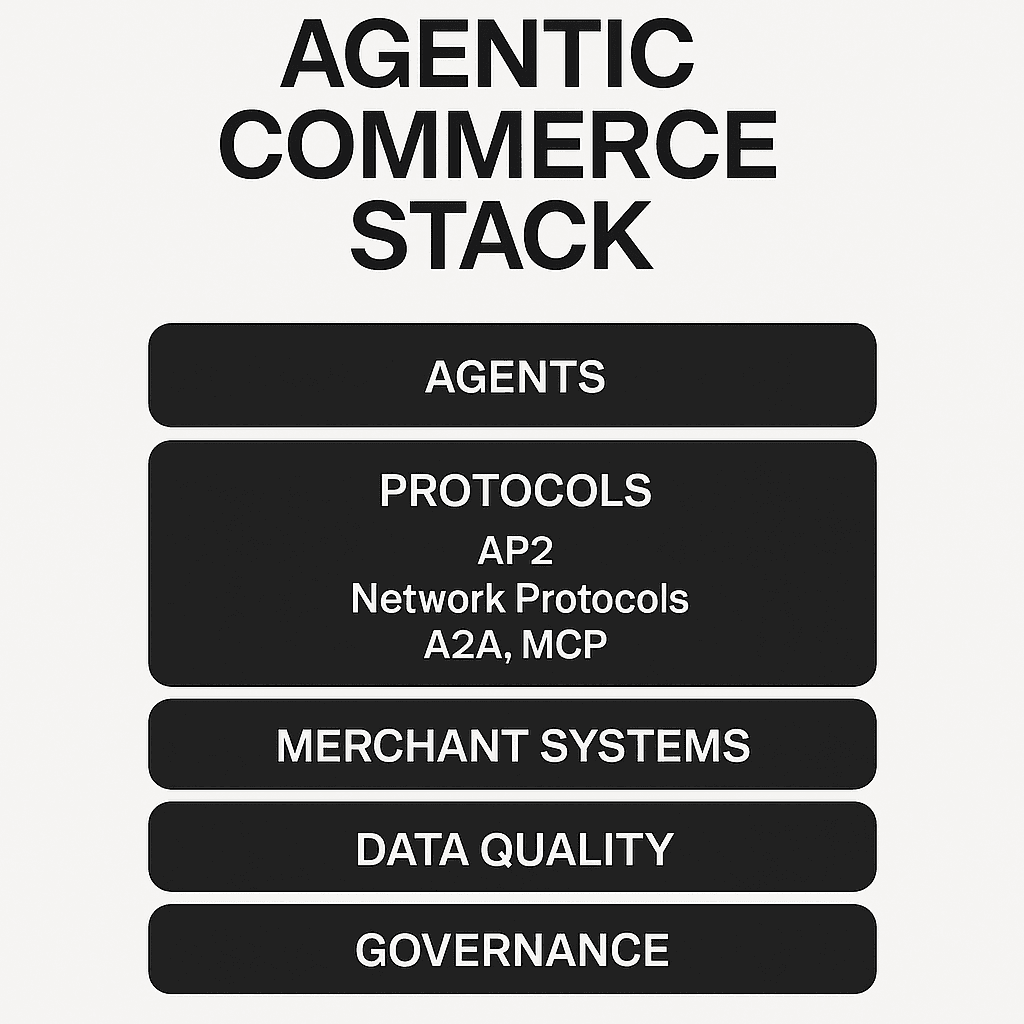
5. How the Agentic Commerce Stack Is Forming
The emerging architecture can be expressed in five layers.
Layer 1: Agents
ChatGPT, Gemini, Claude, merchant-built systems.
Layer 2: Protocols
AP2 for discovery
ACP for checkout
Network protocols for approvals and trust
A2A as an alternative settlement pathway
MCP for tool use and system integration
Layer 3: Merchant Systems
Product data, pricing engines, orchestration, fraud tools, gateways, and settlement platforms.
Layer 4: Data Quality
Structured product data
Pricing consistency
Token and identity integrity
Inventory accuracy
Layer 5: Governance
Transparent logic
Auditability
Rules and human oversight
Security and compliance frameworks
6. What Agentic Commerce Is Not
Agentic commerce is not:
A chatbot
A UI redesign
A new payment method
A marketing channel
A browser extension
It is the automation of the work that currently sits between intent and purchase.
Final Definition
Agentic commerce is a model where AI agents perform discovery, evaluation, and checkout on behalf of customers and merchants using standardised protocols that make transactions predictable, secure, and optimisable.