Agentic Commerce
January 23, 2026
Today's Briefing: January 23rd 2026
NewsAgents Take
Trust remains the gating factor for agentic commerce adoption. Forrester data shows that while consumers expect brands and platforms to market to AI agents, only a minority trust agents to complete purchases on their behalf, and more than half remain uncomfortable sharing personal data with generative AI systems. In parallel, Asia’s super app ecosystems demonstrate what agentic commerce looks like when distribution, identity, payments, and data are already unified, with more than two billion users inside Tencent and Alibaba platforms and increasing integration of autonomous purchasing. The tension between Western trust constraints and Asian ecosystem readiness is becoming a defining structural divergence in how agentic commerce will scale globally.
Consumer trust as the primary constraint
This Forrester analysis focuses on the trust frontier that agentic commerce must cross to reach mass adoption. Forrester data indicates that only around 24 percent of US online adults trust AI agents to act on their behalf for routine purchases, and 54 percent are not comfortable sharing personal information with generative AI tools. These gaps highlight that technical capability is not the binding constraint; governance, consent, and accountability frameworks are.
The article argues that agentic commerce platforms will need clearer consumer protections, dispute resolution mechanisms, and standards to bridge the trust deficit. Without these, agent-driven checkout is likely to remain limited to low-risk and low-value categories.
Super apps as a structural advantage in Asia
This PaymentsJournal piece examines how Tencent and Alibaba are integrating agentic commerce into their super app ecosystems. More than two billion consumers already use these platforms for messaging, shopping, and payments, creating a closed-loop environment where AI agents can execute end-to-end transactions. Alibaba has enabled its Qwen agent to place orders and complete payments directly through Alipay, removing the need for users to leave the conversational interface.
The scale of these ecosystems is a key differentiator. Super apps concentrate identity, payments, and commerce in a single platform, reducing friction that Western platforms must solve through federated standards and partnerships.
https://www.paymentsjournal.com/tencent-and-alibabas-super-apps-evolve-with-agentic-commerce/
Shopify and ChatGPT referral economics
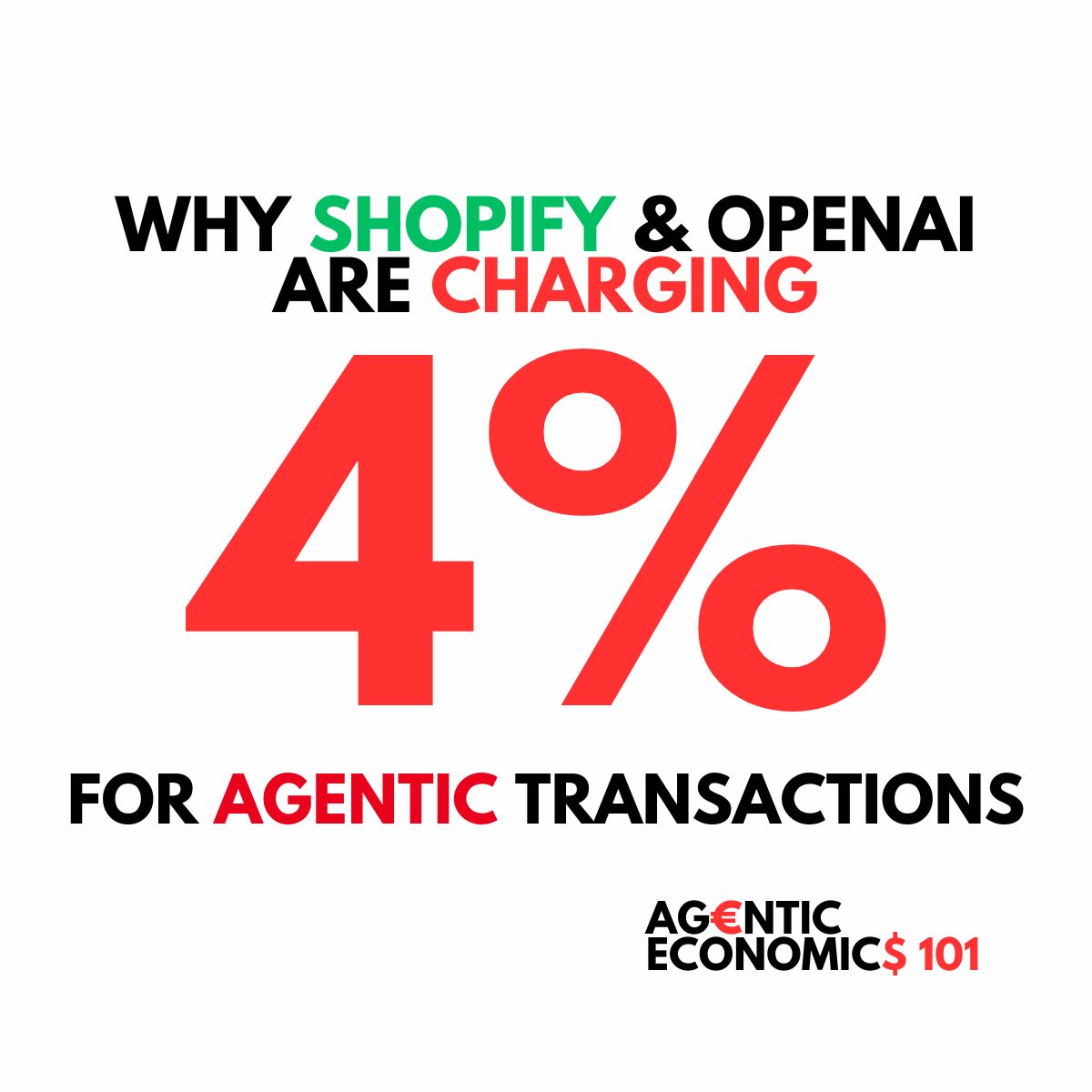
Dwayne Gefferie’s LinkedIn post highlights the reported 4 percent fee associated with Shopify transactions originating via ChatGPT. This reframes agentic commerce economics away from traditional payment processing fees and toward customer acquisition costs. BNPL providers and marketplaces often benchmark referral and distribution fees in the 15 to 30 percent range, making a single-digit agent referral fee potentially competitive for merchants.
The implication is that agentic commerce monetisation may converge with advertising and marketplace referral models rather than traditional payment pricing structures.